Oct 8, 2026
The Office of Sustainability is implementing new recycling, composting, and waste stations across campus to create a more consistent and user-friendly system in alignment with other University System of Georgia (USG) schools and Keep America Beautiful guidelines.
The effort supports Georgia Tech’s goal of becoming a zero-waste campus by 2050. The stations will feature signage to help users properly sort recyclable, compostable, and landfill materials, and they will be securely installed to support safer, more efficient collection processes.
“Standardized, user-friendly signage is one of the most commonly recognized and important ways to encourage landfill diversion, reduce contamination, and work toward our zero-waste goals,” said Jennifer Chirico, associate vice president of Sustainability. “We are excited about Georgia Tech’s commitment to establishing a campus circular economy with this essential step, and we appreciate our partners for collaborating to complete a project of this scale.”
New and Improved Stations
Georgia Tech’s cross-departmental Zero Waste Task Force, a team founded by the Office of Sustainability to increase campus collaboration in advancing circular economy practices, designed the new stations, which will feature:
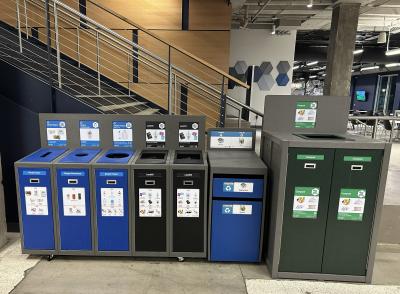
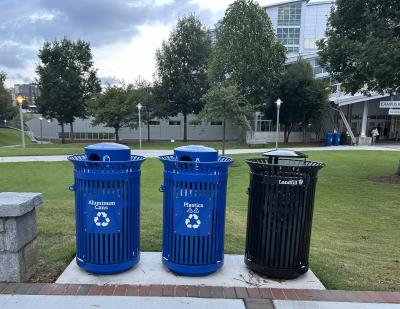
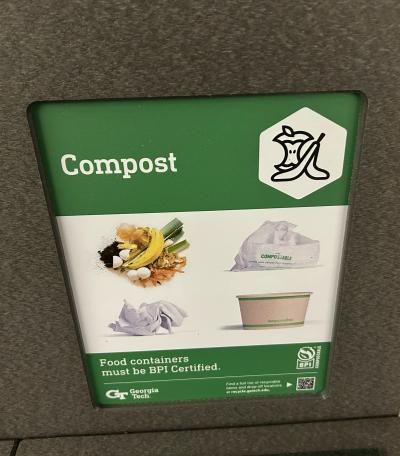
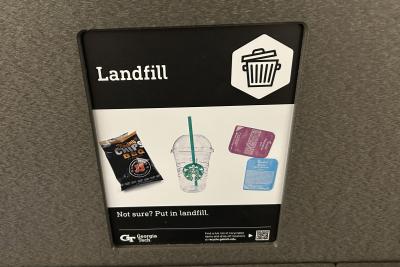
- A consistent color scheme: Aligning with best practices from national organizations and USG peers, standard colors are now blue for recycling, green for compost, and black for landfill.
- Improved signage and visual cues: New recycling stations feature additional signage with detailed information about accepted materials specific to Georgia Tech. Signage files for standard and specialty recyclables are available here.
- Standard layouts: Material streams are laid out in a consistent left-to-right order to help users prioritize recycling and draw the eye to recycling streams first.
- Aggregated, strategically placed outdoor stations: Outdoor stations group each trash can with two recycling cans, shifting the default away from trash and improving collection efficiency. Approximately 65% of outdoor trash cans were previously in standalone locations with no nearby outdoor recycling options.
The campus community can sort and recycle aluminum and plastic types #1 (beverage bottles) and #2 (jugs and bottles) at all new indoor and outdoor stations, plus mixed paper at most indoor stations and compost in select locations. Cardboard recycling continues to be available in dedicated dumpsters and drop-off points throughout campus. A comprehensive list of accepted materials is available on the Zero Waste Resource Hub.
Collaborating to Advance a Circular Economy
Modernizing waste and recycling infrastructure across Georgia Tech’s 400-acre campus and extensive building portfolio required significant coordination, more than two years of planning, and months of implementation, culminating in the refurbishment of nearly 600 outdoor receptacles and the replacement of approximately 300 indoor stations. In addition to staff from the Office of Sustainability and the Office of Solid Waste Management and Recycling, more than 15 campus groups played critical roles in bringing the project to fruition.
It was especially important to the Zero Waste Task Force to ensure that the process of updating campus waste infrastructure did not generate new waste. This goal informed the choice to refurbish outdoor cans rather than purchasing new ones, a decision that saved costs of $1.4 million and extended the useful life of the cans. The old indoor recycling stations are currently being sold, donated, or recycled in accordance with Georgia’s surplus regulations.
"By refurbishing existing receptacles and standardizing waste collection across campus, Georgia Tech has demonstrated that sustainability and fiscal responsibility can go hand in hand,” said Tricia Chastain, executive vice president for Administration and Finance. “This initiative reflects our commitment to being best in class by optimizing resources, reducing waste, and creating a more sustainable future for our campus community.”
The project was funded by Administration and Finance and supported by staff from multiple campus departments:
- Office of Sustainability.
- Office of Solid Waste Management and Recycling.
- Institute Communications.
- Tech Dining.
- Campus Services.
- Student and Campus Event Centers.
- Planning, Design, and Construction.
- Housing and Residence Life.
- Landscape Services.
- Infrastructure and Operations Analytics Department.
- Student Government Association.
- The Kendeda Building for Innovative Sustainable Design.
- Parker H. Petit Institute for Bioengineering and Bioscience.
- Georgia Tech Event Staging Department.
- Georgia Tech Logistics and Surplus.
- Georgia Tech building and facilities managers.
Related Media
-
New-station-in-the-Student-Center.jpg
-
exterior-waste-bin-station.jpg
-
Compost-signage.jpg
-
Landfill-signage.jpg